Clickity Click:

Wednesday, March 21, 2007

Self Portrait in a Convex Mirror

Parmigianino's Self Portrait in a Convex Mirror

by

Varo Borja

In this essay I will attempt to relate to the reader some background information on the Italian Mannerist painter Parmigianino, and also attempt an analysis from three perspectives of one of his major paintings, Self Portrait in a Convex Mirror. The three methods of analysis that I will be utilizing are as follows: Formalism, Semiology (with a hint of Psychoanalysis thrown in for good measure), and Marxism. In conclusion, I will relate to the reader why I feel this work to be of historical as well as contemporary importance.

Girolano Francesco Maria Mazzola, or Parmigianino (little one from Parma) was born the eleventh of January, 1503 as the eighth child of Filippo Mazzola and Maria di ser Guglielmo (Wikipedia, 2007) in Parma, Italy, but was raised by his uncles Pier and Michele Mazzola after his father’s death two years after Parmigianino’s birth. Vasari noted these two uncles as being “modestly talented artitsts” in their own right, and young Parmigianino entered their workshop as an apprentice. He assisted his uncles in the decoration of a chapel in San Giovanni Evangelista, and completed several more works in Parma before moving on to Fontanellato and then Rome. He also became quite adept at drawing, executing an exceptionally large array of pieces on paper, as well as a smaller, but significant number of prints. After fleeing Rome at the invasion of the Imperial German army, he returned to Parma where he became a devotee of alchemy, a sort of magical cult insistent, among other things, on finding a way to convert base metal into gold. He fell out of favor with the church and died young, at the age of 37. He was reportedly buried with a cross of cyprus wood standing erect on his chest.

Parmigianino’s Self Portrait in a Convex Mirror is an intriguing piece, owned by several major collectors of the 16th century, including the pope Clement VII. From a formalist perspective, the painting is done with a limited, monochromatic-like pallette with strictly controlled brushwork and gentle, golden Venetian style light emanating from the window in the upper left background and illuminating Parmigianino’s features. In the words of Vasari, Parmigianino exhibited features of the “divine” (Art of Parmigianino, 2003) and his gentle use of tenebrism and chiaroscuro lends to the elegant nature of the piece and complements Parmigianino’s intention of exhibiting himself not as a common craftsman, but as a sort of lower nobility risen from the ranks and placed within sight of kings and popes by his talent alone.

From a semiotic perspective, Self Portrait in a Convex Mirror exhibits, in my opinion, two main themes. The first involves his use of light and shade. Traditionally, the forces of good and evil (much present in the mind of 16th century Europeans) were grouped as the forces of light as opposed to the forces of darkness. Parmigianino was a man much torn by his affinity for the Catholic Church and his darker side that was drawn to the magical theorems of alchemy. In the painting, light pours from the window and is enveloped in a curtain of darkness lurking on the right and center foregrounds of the painting. Also, in traditional Christian iconography, the forces of heaven are portrayed as being on the right hand of the God facing the viewer, while the forces of darkness are portrayed on the left hand of the enthroned Christ. Parmigianino juxtaposed and jumbled up these two forces in the painting, lending creedence to the crowd who supposed that he was a madman. In the middle sits Parmigianino, bedecked in furs and lace and donning a type of signet ring (a whole sign unto itself), master of both light and dark and the mad genius in control of his own destiny. The other predominant sign that I see in this painting consists of the temporance of youth and the immortality of the soul. From a pragmatic perspective, Parmigianino is seen as a gifted, yet vain usurper of the old school, classical Academicians devoted to linear perspective and defined, logical, almost perfect features. Parmigianino was described as “divine” by Vasari, and indeed, he is well proportioned and exhibits angelic aesthetics. From the course Parmigianino’s life took, ever more towards darkness and distortion, his choice of placing himself within a “convex mirror” was very apropos. Although he is master of his own destiny and in control of the forces of both darkness and light, his precocious intelligence and youthful beauty, as time passes, become ever more stretched and distorted until he is torn asunder by the very forces that he sought to control. In this dichotomy of youth versus eternity, Parmigianino retains the mastery, because although he was in fact torn asunder by his own vain assumptions and outright madness (he died at age 37), he is immortalized in the very painting designed to do just that.

From a Marxist perspective, Parmigianino’s self portrait exhibits most of the common themes associated with Marxism. To achieve relevance with this thread of thought, I feel it is important for the reader to realize a few facts from the life of the painter. He was born into a family of eight children, and his father died of the plague when the artist was two years old. He was raised by his uncles, ever in their shadow until his own talent propelled some in Rome to comment that he was “Rafael reborn” (Wikipedia, 2007). In the classic manner, Parmigianino was a self made man, redolent of sweat and the savor of success at a young age. With this success came the corrupting influence of the nobility and the wealthy bourgeios patrons, ever hungry to consume more talent from the rank and file of the proletariat. Born into a family of artisans, risen to the rank of petty noble and destroyed by the very success he savored, Parmigianino is a classic case of the self made man turned sellout and torn to pieces by the class of wealthy, landowning oppressors at the top of the economic food chain. Parmigianino’s ostentatious display of finery such as his lace ruffled shirt and fur lined tunic is clearly, although somewhat tastefully, nouveau riche in style, juxtaposed with his angelic, self satisfied and “forgetful of his origins”serene face saying to all who view him that this is truly a man of the world. Probably the most conspicuous indicator that Parmigianino was a class climber was his choice of recipients for this masterful depiction of the young up and comer: Pope Clement VII, the very pinnacle of the 16th century social ladder.

In conclusion, I feel it is important for the reader to realize two things about this painting concerning its historical and contemporary value. From a historical perspective, this painting was groundbreaking in style as well as content. As a proponent of the new style today called Mannerism, Parmigianino was one of those who cast aside the traditional, classical, or “perfect” ideal of the luminaries of the Rennaisance, creating a place in the mind of man for the abstract and the dark. Not dark in the sense of medieval or gothic superstitions and chicanery, but dark in the psychological sense. Man confronting himself in a mirror and finding the result to be convex, elongated, torn by conflicting ideologies and desires, erotic yet spriritual, but above all, beautiful and to be desired by angels and demons alike. From a contemporary perspective, Self Portrait in a Convex Mirror beckons us to take an inventory of our own souls. What are our limitations? What can we see within ourselves that is beautiful, or erotic, or vain, or desirous of the light emanating from our cell of solitude, surrounded by darkness and yet undaunted by the voices from the shadows telling us to not reach for the clouds, not to stretch ourselves to master our own destinies? Yes, Parmigianino was a type of visionary, a seer capturing somewhat the feelings of all men and women on his canvas, both the darkness and the light, the young and the eternal, and for that his place in history and the limitless future is secure.

Bibliography

The Art of Parmigianino. David Franklin with an essay by David Ekserdjian: Yale University Press, New Haven and London. 2003.

Wikipedia. Found at: http://en.wikipedia.org/wiki/Parmigianino

Vasari: Lives of the Artists. Found at: http://www.efn.org/~acd/vite/VasariLives.html

Mannerism: The Crisis of the Renaissance and the Origin of Modern Art. Arnold Hauser: Routledge and Kegan Paul, London. 1965.

Tuesday, March 13, 2007

Dolly (Unfinished)

Dolly

By

Varo Borja

Red Charles of the Ritz looks lovely with a black eye. And a busted lip. My name is Dolly. Dolly Divine.
My cigarette tastes like blood and candy and I’m coming down off that cheap cocaine that the jackass in the next room fed me to get in my pants. Haha. He doesn’t know that I have his wallet stashed in my pretty pink panties and no time to waste with 35 year old, small dicked used car salesmen who can’t get it up unless they’re beating on a woman and cheating on their wives with everything in a skirt. So I grab my pink purse with the silver sequins and I hit the door. I’m down the stairs of this dive in a wink of the eye and out on the street again. The night air is cool and damp, but reassuring. It hides me and my bruises and my bad teeth and my bad dye job that I shoplifted from Walgreens. My heels are too high and they hurt my feet so I take them off and go barefoot. Barefoot and pregnant. That’s what Daddy said. Ever since that nigger raped me back in Memphis last year though, the doc at the emergency room said I could forget about babies. So I came to L.A. All 85 lbs of me with a duffel bag and a dream. I wanted to be a movie star. Just like Marilyn Monroe. Little did I know that there wasn’t much need for movie stars anymore. At least ones from Mississippi. That’s what that man in the white limousine said. He said that I could make it in the porn business. I’d never even seen a porno (besides Daddy’s magazines under the mattress) until I came out here and was in a couple of them. Well, I wasn’t really in them. The man in the limousine said that since I was sixteen that I’d have to be a fluff girl. You know them ones who stand out in the hallway while they’re shooting and keeps the stars erect. The ones that they send out for coffee and cigarettes and that they beat up on when they’re bored. I’ve been beat up a lot. Daddy said that I deserved it. When a man hits me I feel like I’m getting the best of him, and then when I spit blood on the floor and pretty myself up again he loves me just like Daddy did.

The neon lights on sunset remind me of those country western songs that I used to hear on the radio on warm summer’s nights back in Mississippi. I’ve been here in L.A. for a while now, but I still can’t get over them neon signs. One day my name will be written on one of them. I can see it now. Dolly Divine, mistress of the night. I like that. Mistress of the night was one of them dimestore novels that I read when I was a kid. Well, I guess I am still a kid. But L.A. has a way of making you not feel like a kid. A way of making you tough on the outside and all cold on the inside. A way of growing you into a stone statue like them Confederate ones back in Vicksburg.

I’m hungry. I stop walking down Sunset for a minute and pull that hard dick’s wallet out from underneath my leather skirt. 50 bucks, a couple of credit cards and a photo of one of his kids. She looks all pretty with her high school cheerleader’s uniform on and her braces and her face free from blue-black love taps. I stand for a moment and gaze at the photo. I look into her soul. Yeah. She’s got scars. They’re just not on the outside.

I walk into a 7/11 and grab a bag of chips, a Snicker’s bar and a big gulp filled to the rim with 44 oz of Mountain Dew. I walk to the counter and the Arab clerk eyes me suspiciously as I pull out my newly won plastic money and slap it down on the counter next to my dinner like I own the place. I give him a wink and a half caste kind of smile that doesn’t show the bad part of my teeth and say “Its my Daddy’s” and he swipes the card. He hands me the little slip for me to sign and I scribble the name of the jackass that it belongs to in a really feathery way like I think a man of his upbringing might, and then I grab my loot and I’m back on the street.

I sit down outside of the 7/11 on the curb that smells of gasoline and stale piss and I open my chips and nibble a little bit. My stomach hurts nearly all the time, and even though I know with my head that I’m hungry, I can’t seem to stomach all the food. So, I toss the Snicker’s bar and the half empty bag of chips to a bum lying on his back in a liquor soaked fantasy land by the blue and white payphone (I keep the Mountain Dew; I hate water and coffee and Mountain Dew reminds me of Mississippi) and then I start to walk down Sunset again to look for someone to take me home so I don’t have to sleep in some alley that smells of the bums and the dregs of some B movie horrorshow.

Monday, March 12, 2007

The Rooms (Unfinished)

The Rooms (Unfinished)

by

Varo Borja


Anna sipped her vermouth silently pretending all the while that it was the blood of the man who had left her in this dive holding the check and none of the cards. She wore a black dress, silky and soft and high, high stiletto heels that made her wince just a little when she stepped to the left and out of the narrow confines of the perspective into which she had been placed. Slow jazz reverberated in the smoke filled air as some half caste gypsy savant blew timorous notes from his tenor saxophone, serenading the last call lowlifes and fat businessmen in cheapish business casual attire slovenly slurping the mid grade whiskey that they couldn’t even taste anymore because they had drunk for abandon and the release that a night out of town and away from three kids and a sagging bottom wife could afford them. The signs were good that Anna would be able to scrape one of these fatted calves from his barstool, get him to pay the check, and sneak out of his hotel room while he was puking his guts out in the bidet or the sink or the bathtub. At one time Anna had been a looker. Hell, she still was but she was past the point of her ripest maturity and her 34 DD breasts had turned to 36 E’s over the last five years and her ankles were a bit larger than when she had won that swimsuit competition in Austin years ago. Her dark hair was still as lustrous as ever though, and her almond eyes still could be playful, or conciliatory, or knife like, depending on the situation and whatever was expedient. She’d had her tubes tied years ago after she’d had her third miscarriage and swore that she’d never get pregnant again, regardless of how much her biological clock demanded the retribution of her sex. Anna’s skin was still very good also, and she took care to keep out of the sun and always found time to cleanse, exfoliate, and moisturize her way into keeping the dogs of middle age at bay.

“Hey honey. Wanna buy me drink?” Anna said as she sauntered over to a 300 lb. man tanned hulk in a Brooks Brothers sport coat.

“Suuurrreee. Take’ll ya what? Vurmooth?”

“Sure, sweetie. You look right handsome tonight. You in the for the conference?” Anna could lay it on thick when the need arose, there was always a conference, and the bartender, Fat Mike was giving her the sign that it was now or never.

“Yayah. Its aw-full-ee hot in here, ain’t it?”

Anna noticed the absence of orangish goo around the barbarian’s left ring finger, indicating the fact that his man tan was recently acquired and hadn’t yet penetrated the bonds of matrimony.

“Why yes it is, darlin’. Don’t ya think that we should go somewhere cooler? Say, your room at the Clarion?” Anna prayed silently to the virgin that his room was at least at the Comfort. She threw in an extra Hail Mary for a suite at the Quality.

“Ummm. I’m stayin’ at the Sleep o-vur on Bristol. You wanna cum?”

Anna cringed. These days it was tough to find a man with taste, let alone decency, but she was in dire straits and in need of a lift to her apartment on Manchester. Bristol was a block away and if she took her stiletto’s off, she could easily sneak out with the buffoon’s wallet and make a B-line to her own bed where Max, her black manx patiently awaited her arrival.

“Honey, you’re sweet as apple pie. Anybody ever told you that your jawline resembles Matt Damon’s? You could pass for him any day under the sun.” Anna silently snickered to herself and ran her hand across the prodigious back of the lamb being led to the slaughter.

“Nah. You ain’t a hooowar are ya?” said Mr. Sleep.

“Honey, I’m anything you want me to be, and a hell of a lot that you can’t handle. We ready to blow this pop stand or not, sugarbritches?” Anna loathed being called a whore and her saccharine seduction was wearing thin at the seams, much like Mr. Sleep’s overstuffed, badly cut blazer.

“Okay. But you gotta drive. I’ve had too drink toooo much.” Mr. Sleep stood up slowly, bracing himself on Anna’s left breast and tottering ever so slightly, much like a weeble wobble that’s had a few too many Jim Beams.

Anna and Mr. Sleep (Anna never bothered with names. Her only concern was the size of a man’s wallet and the time it took him to pass out. She did have the last vestiges of a conscience, and the less she actually knew about her prey the better.) made their way to the door after Sleep fumbled about with the tab, spilling the contents of his overstuffed wallet out onto the bar and only being able to reconcile his debt with the help of Fat Mike and…

Friday, March 2, 2007

The Burial of the Count of Orgasz

The Burial of the Count of Orgasz

By

Varo Borja

This is where El Greco sets before us, in a highly compressed form the wisdom he has brought to his art, his knowledge, his expertise, his composite imagination and his expressive power. –Marina Lambaki-Plaka

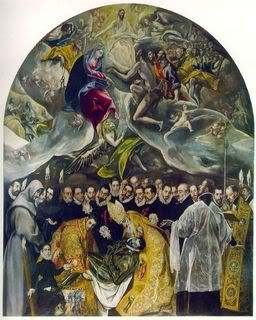
This quote, from a noted Art Historian, sums up the power and majesty unfurled by El Greco (Doménicos Theotokópoulos) in his rendering of the Burial of the Count of Orgasz. In this essay I will relate to the reader a small amount of background on The Burial of the Count of Orgasz, attempt an analysis of this famous painting according to the iconography and allegory used, and also offer a summation of why, in my opinion, this painting has lasting value and an appeal that transcends the barriers of time and nationality.

Considered by most to be his greatest painting, The Burial of the Count of Orgasz is the primary decoration for the funerary chapel of Gonzalo de Ruiz, Lord of Orgasz at the parish church at Santo Tome, in Toledo. Ruiz was a very pious man who reigned beneficently in the late 13th to early 14th centuries in Toledo. At the time of his death (1323 c.e.), he bequeathed an annual donation to the parish church where he was buried, to be collected from the citizens of Orgasz. According to legend, the Count was so pious and had done so many good works that saints Stephen and Augustine miraculously appeared at his burial and lowered his body into the tomb as a sign of holy favor. The parish church where this miracle occurred (Santo Tome), and which also received the generous donation from the citizenry of Orgasz, also happened to be the same church that the master known as El Greco attended mass on a regular basis with his son. According to El Greco of Toledo (Little, Brown and Company, Boston), “Around 1562, the people of Orgasz decided to stop making the annual donation, probably hoping that the memory of the bequest would slip into oblivion.” However, due to the shrewdness of the parish priest, the donation was resumed after an award from the chancellery in Valladolid in the parish’s favor in the matter. The renewed donation allowed for the chapel of the Count to be remodeled, and was substantial enough for a funerary painting to be undertaken. El Greco was named as the painter of the new work, and the result was to be his masterpiece, The Burial of the Count of Orgasz.

According to Wikipedia, El Greco obtained his commission for The Burial of the Count of Orgasz on March 12, 1586. He was given very simple instructions as to the composition of the work, with the primary focus given to the miracle of saints Stephen and Augustine lowering the body of the Count into his grave. It is worth quoting the source of El Greco’s instructions from the parish priest, Andre Nuñez de Madrid, for the painting here, as they are quite brief and illuminate the general composition of the piece:

“This is to be done on canvas down to the epitaph. Below the epitaph there is to be a fresco in which the sepulcher is painted. On the canvas, he is to paint the scene in which the parish priest and other clerics were saying the prayers, about to bury Don Gonzalo de Ruiz, Lord of Orgasz, when Saint Augustine and Saint Stephen descended to bury the body of this gentleman, one holding the head and the other the feet, and placing him in the sepulcher. Around the scene should be many people who are looking at it and, above all this, there is to be an open sky showing the glory of the heavens.” (El Greco of Toledo, pg. 125)

It went without saying that the piece was to have elements reinforcing Counter Reformation doctrine, two of which I will discuss shortly. According to El Greco of Toledo, a lengthy Latin inscription was composed by Dr. Alvar Gomez de Castro (a poet residing in Toledo) that read in part that the chapel was donated “Beneficis et Pietati” –to the beneficent and pious saints, the saints who performed good works. El Greco worked this epitaph into the painting as a means of furthering Counter Reformation theology, which insisted that salvation might be obtained by good works, as well as faith. The impetus for the miracle concerned with the Count was said to have been his lavish donations to the clergy and his beneficence to the poor during his lifetime, thereby confirming that good works were a means to salvation. The Protestants in England, Holland, and Germany, led primarily by the pen of such men as John Calvin, denied the acquisition of salvation by good works and insisted that salvation by grace through faith was the only means of escaping the fires of Hell.

Another important Counter Reformation idea is shown through the content of the work in both zones of the painting. This idea is the intercession of the saints and Mary for entrance into heaven. As is shown, the Count in the earthly realm is being lowered into his grave by saints Augustine and Stephen (Augustine on the right, young Stephen on the left) and in the heavenly realm, the naked and supplicant count is being welcomed in and interceded for by the heavenly saints and the Virgin Mary, who plays a predominant role in the painting. The Virgin is displayed in her typical, Byzantine iconographic garb of red and blue (El Greco hailed originally from Crete, a land under the influence of the Byzantine church) signifying perhaps the blood of Christ and her own tears for the faithful. Christ is displayed in the center of the heavenly realm of the painting in his traditional iconographic loincloth of white (signifying purity), but he is displayed more as an afterthought, or as a type of given in a theorem relying primarily on the emphasis given to the saints and the Virgin Mary. Saints Stephen and Augustine are portrayed in rich vestments of gold and silk, signifying their earthly authority as well as the glory given to them in heaven. The funeral of the count is rendered with a litany of what most scholars believe to be the likenesses of the most famous personages of Toledo at the time, also weeping and interceding for him from an earthly standpoint, therefore giving them accord with the idea of intercession after death by the living, another Counter Reformation tenet.

In conclusion, I feel that it is important to realize that although this painting was executed at a time of great hostility due to the schism of the Church, it retains much that is pertinent to us today. In the lower left hand corner of the painting, El Greco portrayed a likeness of his son Jorge Manuel, with, according to Belinda Coles, a small handkerchief in his pocket. To quote her: “If you were able to take a closer look at this painting, you would find on the handkerchief of the boy in the painting, the artist's own signature, as well as the date '1578' - the year of Jorge Manuel's birth. The boy points to the body of the deceased, thus bringing together birth and death.” The artist is trying to convey a message to us here, I feel, that future generations must continue to uphold that which is right and holy, and to not fear death and the grave. By giving his own son such close proximity with the deceased, it is almost as if he is saying that the human soul dies and is constantly reborn, much as Christ was after his crucifixion and as we can be, through good works as well as faith. Also, El Greco adorned the attendees of the funeral in contemporary dress, signifying the utterly up to date concern of the saints for the souls of the living and the dead, and God’s ever renewed interest in mankind and his attainment of salvation. His depiction of heaven in the work is timeless, reassuring us that underlying all is the assurance of the Blessed Realm, a place of rest and redemption for those that carry out the will of God and live to good purpose here on this temporal plane. El Greco was a man of vision. His work wasn’t truly appreciated until the time of the abstract expressionists such as Jackson Pollack and the cubist movement headed by Picasso. With such a far reaching legacy in the field of painting, and the powerful allegories that he presented, El Greco is truly one of the great masters of Westen Art, and The Count of Orgasz, as his masterpiece, one of the greatest paintings of all time.

Bibliography

El Greco of Toledo: Johnathon Brown, William B. Jordan, Richard L. Kagan, Alfonso E. Perez-Sanchez. Little Brown and Company, Boston. 1982.

Wikipedia: found at: http://en.wikipedia.org/wiki/El_Greco

Belinda Coles.htm: found at: http://www.edu.pe.ca/rural/class_webs/art/belinda_coles.htm